
Every spring I remind myself to check my first aid kit for expired medications, reduced supplies that were used during the previous season – all part of a simple inventory of quantities and qualities of gear I anticipate using in the months to come.
I also like to review treatment protocols and processes for administering first aid in the field – a refresher course of skills and tips I may have forgotten or need refining as well as a new technique or two to add to my mental library. A few first aid topics came to mine, so I share them now – and hoping you never need to call upon them in the field.
I go through countless bandaids each year, either for my own wound covering or in response to myriad cuts and scraps to those around me. Besides the common one-inch adhesive bandage we all know, the butterfly bandage comes in a close second for being a great wound sealer of back-country cuts – and consequently is constantly in need of re-supply in my kit. Since the regular adhesive strip is usually more plentiful, it’s convenient to make a butterfly-type bandage from the common bandaid.
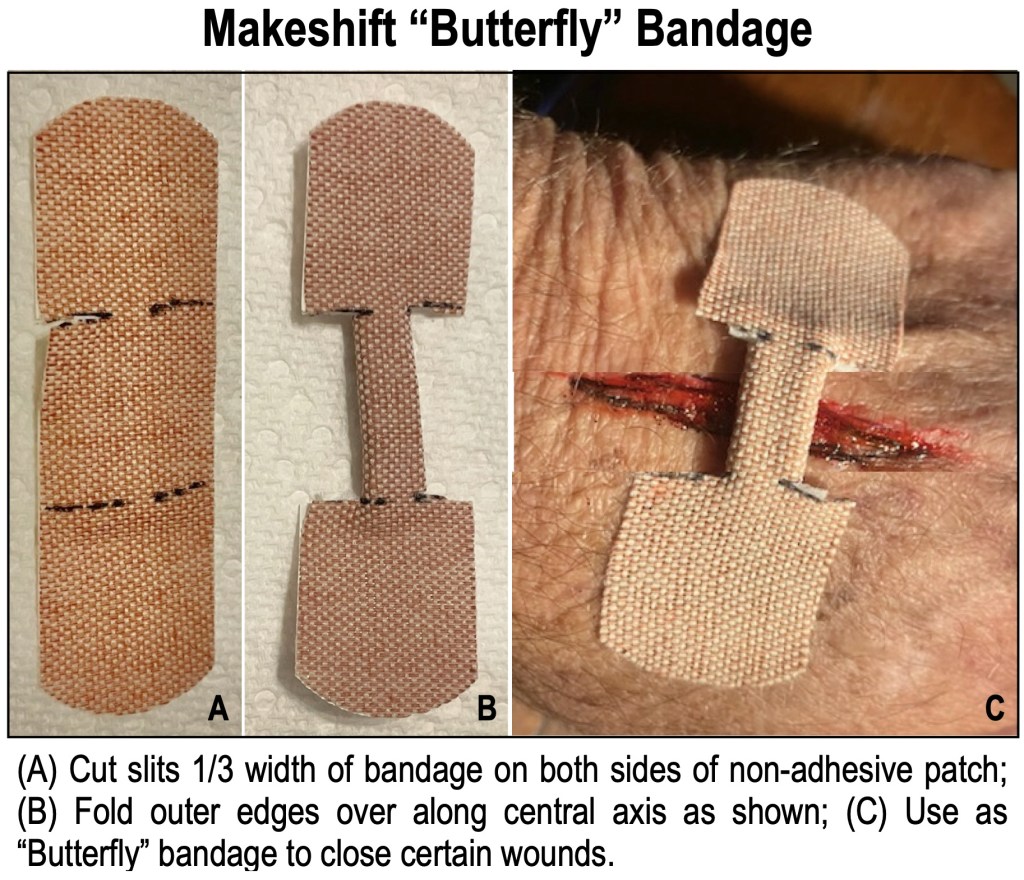
The absorbing pad can be modified with cuts l/3 of the way in from each edge of the pad. You can then fold the outer third of the pad length over to create a non-adhering center strip (just like on a regular butterfly center) and affix it to a wound that needs to be pulled together. This modified butterfly can be made from most any size of adhesive strip available.
Most open wounds need to be cleaned out before applying bandaging typically by flushing the immediate area with water to remove any foreign debris. Some first aid kits come equipped with a small syringe for that very purpose. In lieu of this device, a very effective water flushing aid is a simple food storage bag.

Filled with water and snipping the smallest tip of the bag’s corner off creates a very effective and controllable wound flushing tool.
Remembering which plants can be used for native, folk medicine treatments can be vital information in many first aid situations. The juice of the jewelweed plant to treat poison ivy; the tea made from the bark/twigs of the willow tree for “aspirin” or the many poultices for insect stings are among literally hundreds of regionalized, back-country remedies. Many natural antiseptic plants grow in myriad environments and can be called upon to treat most skin-breaking wounds.

Wooly yarrow is a common plant that can be mashed down into a paste and applied to a wound. Sphagnum moss is even simpler – it’s smaller, fresher sprigs can be used directly on a wound to provide some antiseptic healing as well. Clean the wound, apply the plant as you would any suave or ointment and then cover it all with a bandage or wrap.
Sprained or broken limbs, themselves a serious injury, can become even more life threatening if it limits your ability to travel out of harm’s way. Kits often contain one of the many sized/shaped moldable “SAM” splints, most suited/designed for immobilizing fingers on up to forearms. There are often several items in a campsite that are also quite adequate for making into a supportive, immobilizing splint.
The simplest arm injury first aid is one learned early on by most boy scouts – a sling made from a triangular bandana. Its function is to cradle the injured arm and limit mobility. Virtually any piece of cloth can be configured into a serviceable sling.

A more supportive treatment is to split the arm so it can’t move and also providing a protective outer shell/layer against the injured area. In addition to commercial inflatable air splints, anything that can be formed around the arm and provide rigid support can be used: rolled magazines/newspapers; slats of wood or sticks, slabs of tree bark, etc..
Before you head out to your own favorite back-country haunts, take a few minutes to make sure vital components of kits are fresh and plentiful. Give yourself a quick refresher course on the skills and tips you know you know, but have maybe gotten a bit cold or stale on some of the details.
Something I’ve found very helpful is to sit down with the first aid guide that comes with most kits. Familiarizing yourself with its layout and content can help you quickly skim through the information and find the instruction you may need for a particular injury.
There’s always room to learn more and there’s no better time than right now to get started.
Be Safe, Be Smart, Have Fun out there!


 TOMOUTDOORS.COM
Leave a comment